I have a new post over on the Companion Bird World Blog … just a short one. Hop over and take a look.
http://companionbirdworld.blogspot.com/2013/05/the-instant-expert.html
Sid.
I have a new post over on the Companion Bird World Blog … just a short one. Hop over and take a look.
http://companionbirdworld.blogspot.com/2013/05/the-instant-expert.html
Sid.
One often hears about this procedure in connection with undesirable behaviors such as excessively loud vocalization by companion parrots. It is also a term that is often used incorrectly so here is a short discussion of extinction.
In operant training, the procedure of withholding the reinforcers that maintain a behavior.
Paul Chance – Learning and Behavior.
While this is fairly simple to understand there are a couple of challenges with the use of this procedure. First it requires that the trainer really knows what the reinforcers are that are maintaining a behavior. In addition to this the trainer needs control of those reinforcers and sometimes the reinforcers are not in our control, making the application of extinction just not possible.
There is one more term that is worth discussing here with extinction and that is the extinction burst.
A sudden increase in the rate of behavior during the early stages of extinction.
Paul Chance, Learning and Behavior.
This effect of the extinction procedure is one that can set the caretaker of the parrot up to end up reinforcing a higher level vocalization just because they cannot stand the extinction burst level and they reinforce the higher level by reacting to it. This reinforcement, because it is not delivered after every vocalization is what is called intermittent reinforcement. A term to be discussed in a future article. For now the important part of understanding intermittent reinforcement is that it builds behavior that is more resistant to extinction. This serves to make the effective application of an extinction procedure even more difficult.
Undesirable loud noises, typically referred to as “screaming” by parrot owners, is a common issue. So common that it inspired me to tailor a presentation for conferences and bird clubs called “The Accidental Trainer”. The basis of the presentation is that screaming and also biting, are so prevalent in companion parrots that they must be inherently “noisy biters.” It is not my intention to cover the ground that my presentation covers in a few hundred words of a blog, I encourage anyone interested to contact me so that I may bring the full presentation to their club. What I would like to discuss is the often advised strategy of behavior change called “extinction” as a solution to the noise issue. My point will be that extinction alone is not enough, indeed suggesting only extinction as a fix for a noisy bird may well be setting up the bird and the caretaker for failure.
First let’s take a quick look at exactly what we mean when we speak about extinction. The word itself and its common meaning sound like the right approach:
Extinction – Noun
1. The state or process of a species, family, or larger group being or becoming extinct.
2. The state or process of ceasing or causing something to cease to exist.
The first definition is obvious and is probably the one that people are most familiar with. The second definition is not surprising either and seems to be what we want with this noisy bird behavior, we want it to cease to exist, the behavior that is 😮
From a behavior science perspective we get a tighter definition, one that leads to how to apply the strategy:
1. When a behavior that has been previously reinforced no longer produces reinforcing consequences the behavior gradually stops occurring.
This also seems clear, we simply ensure that whatever consequence has been reinforcing the behavior is no longer available. Simple right? Well not so much. The first challenge in any attempt to reduce the frequency or strength of an undesired behavior is to try to discover two things. First what is the signal in the environment that informs the bird that if they vocalize loudly it will produce a desirable outcome? Second, what is that desirable outcome produced by the behavior of vocalizing loudly that is maintaining the behavior. Only once these two things are discovered and in our control do have the tools to enable an attempt to reduce the undesirable behavior.
If we are lucky we will discover and be able to control the event that is signaling the bird to begin the behavior. For example I have heard of a bird that was placed in a cage near a window and their caretaker discovered that each time a large hawk appeared on the bird table in the yard their bird would begin screaming very loudly. The caretaker would appear and talk to the bird or bring it treats to calm it. For this situation the owner chose to move the bird table into the rear garden, out of sight of the parrot … the screaming went away. The signal to the bird to scream had been removed.
More often the signal to scream is the caretaker leaving the bird alone by going to another room. In these cases not leaving the room is probably not an option. This is when many trainers advise the use of extinction, “Just DO NOT respond when the bird screams” becomes the mantra. This advice on its own is not setting up the bird or the caretaker for success. While extinction does work and has been proven to work through countless experiments it is just too hard to execute properly for most caretakers.
What the advice to use extinction is ignoring is the principle that all behavior has function. This means that the behavior of screaming is used by the bird to generate some desirable outcome. It is part of the bird’s control over its environment. A much more successful strategy asks the question, from the bird’s perspective, “What’s in it for me?” If we can figure out what the outcome the bird expects the screaming to deliver then perhaps we can work out a different, more acceptable way of the bird getting that outcome.
Many times the screaming escalated from initial much lower volume attempts by the bird to simply stay in contact with the caretaker when they left the room. If we have a bird trying to make contact then we can begin by heavily reinforcing an acceptable vocalization, while trying to ignore the loud stuff as much as possible. When the caretaker leaves the room they can reinforce the acceptable noises by responding and fulfill the function of the vocalization, assuming contact is the bird’s desired outcome.
However, there are times I hear of screaming birds that do not respond to this strategy, usually because the noise is about getting the caretaker to return to the room and not simply vocal contact. In such cases how can we replace the function of getting the caretaker to return? It may well be we cannot directly do that. Now the strategy becomes one of developing a degree of independence for the bird. This is where teaching your bird to interact with toys and also to forage for food may come to the rescue. A bird that is engaged in independent play is much less likely to “demand” the caretaker return to the room if just prior to leaving the caretaker refreshed the foraging toys or placed some other toy in the cage for their bird.
In closing I must say that this short blog is just an attempt to get caretakers to think about strategies that do not reply upon extinction alone. By just removing access to reinforcers that previously maintained a behavior we are likely setting the stage for escalating noise or other undesirable behaviors. Teaching our birds to forage and play independently will go a long way to reducing the likelihood of screaming for attention behaviors.
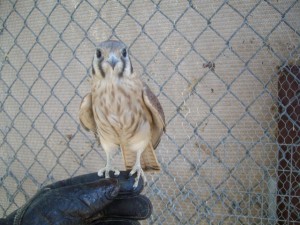
We are in the process of organizing and promoting the 2013 Raptor Handling Class. This will be the 10th year of presenting this class that was was conceived to raise the bar for anyone working with raptors in education programs. Over the years we have collected some wonderful comments from our attendees with our end-of-class survey. However, just a few days ago I received the following in an email from Joan Cass who came to the 2012 class from the Tucson Wildlife Center in Tucson, AZ.
Hello! I took the class last summer, and I wanted to tell you of my progress. When I returned to Tucson Wildlife Center here in Tucson, I began working with our three-year-old imprinted American kestrel falcon. She was used to coming to the glove for food but not much more. After new jesses were put on, I went daily for three weeks, using yummy mouse organs for rewards. I built her a small transport box and one for our GHOs (photo attached). (They are so wonderfully light and easy to carry!)
Over the weeks and months I slowly introduced out little Kiki to the world, and now she is happy to attend whatever gathering we ask her to. She is used to dogs, generators, running children, and umbrellas. When the breeze comes up she opens her wings (I call it glove surfing) and shows off her lovely tail.
Only once she worried us by ducking and scanning the area. We noticed two Harris’ hawks circling far above us. She had seen the shadow from under the pop-up tent.Thanks for providing this course and giving me the credibility and the confidence to move ahead with her training!
Thank you
Joan Cass
This is exactly why I present this class and this note from Joan is great reinforcement. Please visit this link for information about the 2013 class and raise the bar for the birds in your collection.
Keep soaring, SidI have to admit it is very encouraging to see the growing number of people talking about training these days who are becoming more and more familiar with the science of behavior change. Just every now and then however I am having a conversation or sitting in a meeting and I hear something that makes me think … really? That happened recently and I thought that maybe a short blog telling the story might help people understand this valuable science a little better and also to really think about places in everyday life where we can apply our most positive, least intrusive strategies to behavior change.
The story begins with our “hero” walking in a park behind a group of several young women. The young women are deep in chatter and generally having a great time. They, and our hero, continue through the park in the same direction, at one point one of the young women finishes the candy bar she had been eating. Don’t you hate how young people can eat anything and not gain weight? Anyway, I digress. With the candy bar finished she purposefully throws the wrapper onto the beautifully kept grass alongside the path. Now our hero, who considers herself a good trainer, formulates a plan to attempt to change this behavior. She walks over and picks up the wrapper, taps the young lady on the shoulder, and tells her she dropped something. The young lady sheepishly walks over to a trash can and while being teased by her friends she drops the wrapper into the trash. Feeling pleased to have applied her training knowledge our hero happily sets off home.
In relating this story our hero tells us that as she walked away the teasing of the friends continued and she can imagine that the friends would continue the teasing as their walk continued. She tells us this would lead to reducing the wrapper throwing behavior in the future.
So, do you see what made me think to myself … really?
Here we have an example of focusing ONLY on reducing, or punishing the unwanted behavior with no attempt to build the acceptable behavior. Because of the focus on reducing the wrapper dropping behavior our hero missed a golden opportunity to use the most powerful strategy in our trainers’ toolbox. The power of positive reinforcement. The moment the wrapper was dropped into the trash she could have heavily reinforced that behavior, instead she walked away pleased that the aversives would continue to flow from the friends.
While this is a simple story it nicely illustrates the approach that says rather than focusing on the behavior you don’t want, focus on the behavior that you do want to see and use positive reinforcement to build that desired behavior. It almost makes you want to have a candy bar in your pocket, ready to reinforce the wrapper going into the trash … but not eating the candy bar oneself is a whole other behavioral issue ;o)
Keep soaring,
Sid.
Avian Ambassadors Promote Your Page Too |
|
Share this blog Follow this blog
|
© 2008-2024 Avian Ambassadors and Sid Price All Rights Reserved
Copy Guarded by IamShekhar's WP-CopyGuard.